
GodReflection: Come and See—God Saved the Best for Now
“Come and see,” said Philip (John 1:46). “Everyone brings out the choice wine first and then the cheaper wine after the guests have had too much to drink; but you have saved the best till now” (John 2: 10).
 It had to be one of the greatest blindsides of all history. From the viewpoint of first century Jews God sent the wrong king.
For hundreds of years they told their children the story of King David who conquered all enemies with his sword and his army. He was the king who made wealth flow in the streets. Everyone had plenty. Even while they told the story they spoke of God’s promised Messiah who would come from the lineage of King David and be greater than all of their stories of the shepherd boy.
 Surely, Messiah would arrive as recognizable royalty. In the resemblance of David, he would be a freedom fighter, remove Roman rule and fill everyone’s coffers. We humans know how to color God’s promises with our expectations.
In the introductory first chapter John uses an unknown named Nathanael to introduce King Jesus with the words which denote his surprise when Jesus already knew of his recent activities.
He declares: “Rabbi, you are the Son of God; you are the king of Israel” (1:49). However, in John’s gospel this king never acts like royalty.
He walks, rides donkeys rather than great war horses, and dodges ever attempt by anyone to place a crown on his head. His kingship was to be defined by the Holy—not by the desires of the crowd.
We encounter the Jews as they set the stage for crucifixion. There is one last hurdle. They need Pilates permission. Out of convenience treason is the trumped-up charge. This man wants to be king in the place of Cesar. John invites us to see the Roman Governor Pilate’s vetting of the “would be king”:
Pilate then went back inside the palace, summoned Jesus and asked him, “Are you the king of the Jews?” . . . Jesus said, “My kingdom is not of this world. If it were, my servants would fight to prevent my arrest by the Jewish leaders. But now my kingdom is from another place” . . . “You are a king, then!” said Pilate. Jesus answered, “You say that I am a king . . .” (John 18).
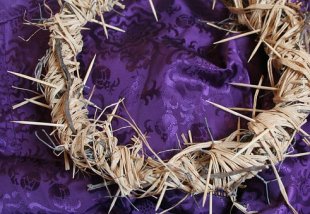 The soldiers twisted together a crown of thorns and put it on his head. They clothed him in a purple robe and went up to him again and again, saying, “Hail, king of the Jews!” And they slapped him in the face.
Once more Pilate came out and said to the Jews gathered there, “Look, I am bringing him out to you to let you know that I find no basis for a charge against him.” When Jesus came out wearing the crown of thorns and the purple robe, Pilate said to them, “Here is the man!” (19:2-5).
Crucifixion is granted to pacify the accusers:
It was the day of Preparation of the Passover; it was about noon. “Here is your king,” Pilate said to the Jews. But they shouted, “Take him away! Take him away! Crucify him!” “Shall I crucify your king?” Pilate asked. “We have no king but Caesar,” the chief priests answered.
 Pilate had a notice prepared and fastened to the cross. It read: jesus of nazareth, the king of the jews (19:14-15,19).
Once again John calls us to come and see. This time the sight is a cross. It is a sad and horrible picture. The king greater than King David is on the cross.
Both Father and Son knew we would come to understand the King made possible God’s best for us. It took the cross to provide His grace to cover all our sin.
The final act of the King was to offer himself for my sin. He had done something David could not. He brought salvation to a creation under the condemnation of Adamic\Satanic sin. Not only was he the King of the Jews, but God made him King over All.
 God’s King Jesus challenges me in ways I have failed to recognize. I dare not stand in judgement of those who misinterpreted his kingship. I think of promises I tend to misinterpret. His promises of the role of Scripture, His vision and activity in the global church of the centuries and His people around the globe.
I think of my own errors as I interpret His faithfulness and the Holy’s vision for eternity. I wonder how often I’ve colored God’s promises by my own expectation with how I think they should look.
Just perhaps, could that be the greatest lesson I need to learn from my encounter with the King greater than David? How often do I wrongly perceive what God is doing?
Stay tuned.
Dr. Gary J. Sorrells
A GodReflection: Come and See the King Greater than David
 God Reflection
Very good post Gary! You gave us much to think about. God bless you.
LikeLike