GodReflection: Talking with God.
 Being raised in a desert town of New Mexico made me all too familiar with thorns. To explore the Yucca-covered hills, abundant with Prickly Pear Cactus and prolific Lechuguilla plants with their hooked-teeth leaves, was to invite a painful thorn encounter. Hands thrust into bushes in search of horn toads or stray baseballs ran the risk of a puncture, bringing on the “ouch-ouch” jig.
The first “ouch” comes with the surprise collision. What makes the incision especially painful is when 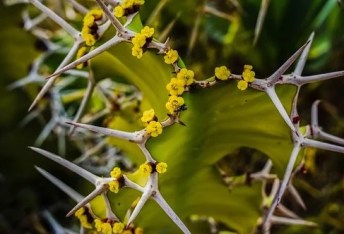 the thorn breaks and remains buried in the flesh. The only pain worse than a thorn’s entrance is its removal. Too deep to dig out and too painful to leave alone, a good thorn puncture is miserable until the small wooden needle works its way to the surface.
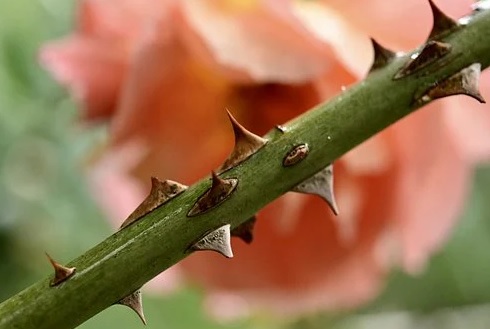
Thorns meet their match in the city where pavement, sidewalks, manicured lawns, and skillful gardeners design parks free of prickly spikes. Sure, there are rose bushes, but their little stickers are a poor imitation of a genuine thorn.
In Paul’s second letter to the church at Corinth, he told a thorn story that likely happened 14 years earlier. There was a celestial encounter with the Holy. He did not seem to understand how it happened, but he was placed in the presence of God the Father, God the Son and God the Spirit. He “heard inexpressible things that no one is permitted to tell” (2 Cor. 12:4). Shortly thereafter, he was given a constant companion, “in order to keep me from becoming conceited . . . there was given me a thorn in my flesh, a messenger of Satan, to torment me” (12:7).
 From my youth spent in a landscape dominate with thorns, I easily identify with Paul’s imagery. The apostle’s throb from a thorn buried deep within is the perfect analogy to describe limitation. Many speculate as to the nature of Paul’s thorn. To read between the lines of his letters written from prison, some surmise the thorn to be an eye disease that caused him to dictate his letters to scribes and sign his name in large characters. Others read, “I have great sorrow and unceasing anguish in my heart. For I could wish that I myself were cursed and cut off from Christ for the sake of my people” (Rom. 9:2-3) and hear Paul’s cry as a thorn of rejection. These readers project probable alienation with his Tarsus’ family brought on by the radiant encounter with Jesus the Messiah on the Damascus Road.
Still others read where Paul writes about marriage and speaks of his own state as a single man. They wonder if the loss of a young woman was the thorn he carried inside. Did an old Jewish father cancel the promise of his daughter’s engagement? What Jewish dad would give his daughter to a young fellow who promoted nonsense about a crucified Messiah?
Whatever it was, Paul called this constant companion a thorn. Three times he asked God to remove it, but God had a better idea. By learning to dance around the thorn, it turned into a daily reminder of dependence upon God. After his third request for removal, Paul recorded God’s response: “But He said to me, ‘My grace is sufficient for you, for my power is made perfect in weakness’” (2 Cor. 12:9).
In our celebrity-driven world, we hear loud and clear that perfect looks, articulate speech, big bucks and high extroversion get the job done. I don’t doubt that God uses talent-packed people. However, I have difficulty when I align my gift set with cultural expectations. How about you? By contrast, Paul tells me to list my weaknesses on my resume.
 Wow, what a list of weaknesses I could compose if only I had courage to share. Suddenly, my resource for resume bullet points expands considerably. Is it possible Paul was on to something? Is it possible for weakness to become a word of power to guide my walk? Am I in conversation with God about my weaknesses? It grows from earlier in his letter. Paul cannot leave the idea alone. Prior to his thorn reference he shared this golden nugget: “But we have this treasure in jars of clay to show that this all-surpassing power is from God and not from us” (2 Cor. 4:7).
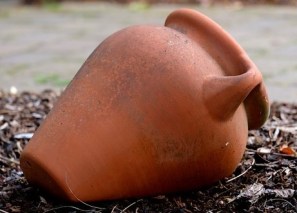
Even though I may like the idea of strength, the truth is no matter how blessed we may be with talent, riches, or beauty, every one of us belong to the community of clay pots. Weakness is inherent with our Adamic clay. I am human not God. I am a clay pot, not a container made of steel. With ease I crack and shatter.
Weakness is a thorn from a human point of view. As I attempt to identify with the weakness and pain of Jesus on the cross, I want to grow in greater awareness of God’s design to shine through my weakness. Do I ask God to use of my weakness to help me be a more effective reflection of Jesus? For it is through His use of my frailness that it is possible to live by His power and be His instrument to create light for others.
I want to join with the apostle Paul in the Thorn Dance. My challenge is to trust God while I dance with the thorn. My thorn allows Jesus the space to guide my walk across His earth. On those occasions when I find myself used as an instrument for good, since there is no way for such power to come from thorn-produced weakness, it becomes easier both for me and for on-lookers to give glory to God the Father, God the Son and God the Spirit.
Through three, thorn carrying Jesus followers, the apostles Paul, Peter, and Jesus’ brother James, I meet the God who gives only good gifts. Sharp, painful thorns are thrust into us by Satan to distract us.  However, God allows thorns to be used for good, rather than for harmful purposes. God the gardener is in the business of transformation. He turns thorns into roses. While He goes about the remake of our thorn into a rose, He assures us that His power shines through. From punctured clay flowerpots, God’s power glows, bringing light into a dark world.
The sufficiency of grace is a lifelong challenge. It is a truth that I know in my head but one that needs a daily reminder to grow in my heart. I think I see progress. The thorn to rose imagery helps. The thorns Satan shoots into our flesh or into our soul cannot kill or derail us if we entrust them to Jesus. And as we dance, we live in confidence that God will provide us the grace to keep on keeping on while He is at work to morph our thorn into a flower for His glory.
Don’t you suspect we all have a thorn or two that God wants to transform into a Rose if only we would talk with Him about it?
Stay tuned.
Dr. Gary J. Sorrells
A GodReflection, Let’s Talk Thorn Dances and Roses with God.
 God Reflection
Very helpful reflections Gary. Thanks for this reminder that our weaknesses can be used by God as strengths.
LikeLike
Bryan,
Always appreciate you reading with me. Yes, when we are down, we must remember that he is always the one who carries the load. It great to be aboard for the ride.
Gary
LikeLike
Thanks, Gary. Brings back memories. My siblings and I went barefoot all summer. The thorns I hated were the grass burrs. They really hurt no matter how tough your feet got.
LikeLike
Greta,
Do I remember the grass burrs! Didn’t our desert have some wonderful stickers.
Who would have known they would provide such a helpful analogy to remind us of God’s care for his family? Good to hear from you.
Gary
LikeLike
Oh, Gary, what a resume of weaknesses I could list! Thanks be to God for his Grace. Thanks for a great post.
LikeLike
Deryl, Great to hear from you. You are right. Thanks be to God’s Grace. It’s neat to know the Holy God covers the cracks with the Roses he creates.
Gary
LikeLike